- The Playbook
- Posts
- Shoppers are Hunting Disappointment
Shoppers are Hunting Disappointment
🤨They ask what might go wrong next, and more!

Welcome to The Playbook—your backstage pass to marketing mastery. We don’t just share tips; we hand you strategies to dominate the field. Get ready and make bold moves in the ever-evolving marketing game. 🎯
🤨 Shoppers Are Hunting Disappointment
Most people don’t abandon a product page because they are unconvinced.
They leave because their internal debate never resolves.
They scroll. They nod. They hesitate. They open another tab. This is the part most CRO work misunderstands.
Buyers are not asking, “Is this good?”
They are asking, “Which part of this might disappoint me?”
And if your page does not answer that exact fear at the exact moment it forms, the brain fills in the gap itself. Usually with skepticism.
That is why adding more reviews stops working. That is why stronger copy plateaus. That is why beautiful PDPs still leak intent. The issue is not missing proof. It is misaligned reassurance.
The invisible argument happening in the buyer’s head
Every PDP triggers a quiet sequence of micro-questions:
Will this actually work for someone like me?
Is there a catch they are not showing?
What happens if this arrives late, wrong, or disappointing?
Am I going to regret this?
These questions are not asked out loud. They surface as pauses.
If your page forces the buyer to search for reassurance, you lose them. Decision confidence is fragile. It has a short half-life.
The brands that convert consistently do one thing differently.
They do not “prove the product.” They preempt regret.
Reframing proof as decision timing, not content
Most teams treat proof as content blocks. Testimonials here. Badges there. UGC somewhere below the fold.
High-performing pages treat proof as interruptions.
They insert reassurance at the exact moment doubt would otherwise take over.
Not later. Not grouped. Not buried.
When the buyer wonders about results, proof appears instantly. When they hesitate at sizing, proof resolves the uncertainty in place.
When they scan shipping or returns, certainty replaces anxiety. The page stops feeling like persuasion and starts feeling like guidance.
Why random proof fails even when it is strong
A before-and-after placed too early feels like hype. A certification placed too late feels defensive. A review without context feels generic.
Strong proof in the wrong location creates friction instead of trust. The buyer feels pushed instead of supported.
This is why many brands see no lift after adding better assets. The issue is not credibility. It is choreography.
How top teams quietly fix this
They stop thinking in sections and start thinking in decision points.
They map where hesitation naturally appears, not where design allows content.
They design the page as a sequence of resolved doubts.
They treat reassurance as a utility, not a persuasion tactic.
Creator content becomes especially powerful here when it is used surgically. Not as social proof wallpaper, but as claim-specific validation.
Tools like Insense help teams fill these gaps precisely, producing creator assets that answer one objection cleanly instead of trying to sell the entire product again. When proof is generated with intent, not volume, conversion stops relying on luck.
You can book a free strategy call by today and get $200 toward your first collaboration if you want to audit where your PDP is leaking belief.
The quiet advantage most brands never build
When objections are answered before they fully form, shoppers do not feel convinced. They feel safe. And safety is what turns interest into action.
The best PDPs do not overwhelm. They do not impress. They do not argue.
They simply remove every reason not to buy, one at a time, until the decision feels obvious.
That is what real conversion optimization looks like when it is done properly.
PARTNERSHIP WITH LINDY
You are not behind on ideas. You are behind on speed.
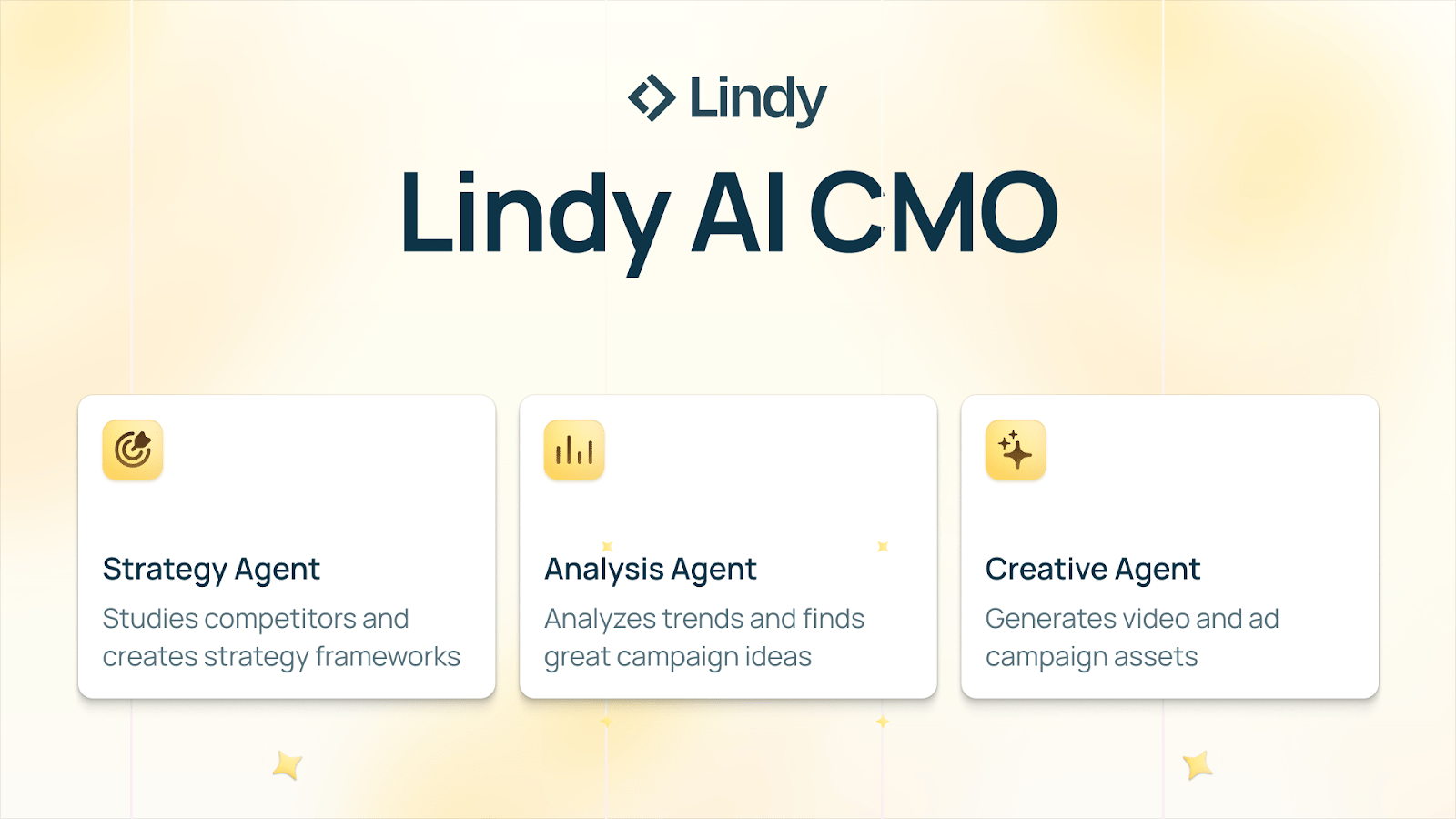
You know the drill. Competitor research scattered across tabs, unfinished messaging docs, late briefs, and creative that misses the angle. That chaos is not annoying; it is expensive.
Lindy AI CMO is a suite of powerful agents that ship beautiful marketing campaigns quickly.
Drop in your website, and agents study your competitors, extract angles, draft messaging, create briefs, and generate launch-ready assets, then organize everything in Airtable for a clean approval flow.
Cut campaign prep from 10 to 14 days down to 1 to 2 days.
Generate 30 to 80 on-brief variants per angle to accelerate testing.
Reduce rework and increase weekly experiment volume without extra headcount.
Teams running agent-led workflows consistently ship 2 to 3 times more weekly tests with the same headcount.
🚀Quick Hits
📉 Meta’s latest enforcement report shows less than 1% of content was removed and “precision” hit 90%, but proactive detection of bullying and hate dropped sharply as fake accounts still account for roughly 4%, or over 140 million profiles.
📺 Pinterest is acquiring CTV ad platform tvScientific to bring its 600 million user shopping signals into outcome-based TV ads, adding automated buying, AI optimization, and 15,000 audience segments as it expands Performance+ across new screens.
🔍 Bing is testing Google-style grouped “Sponsored results” blocks where only the first ad is labeled, making paid links blend into organic results and raising concerns after 63% of Google users reported accidental clicks in similar layouts.
🛒 New Bain data shows 70% of U.S. consumers now use AI, 45% daily, with zero click AI overviews handling 65% of product searches, while only 25% trust an agentic AI to manage end-to-end shopping.
💪Tweet Of The Day
Advertise with Us
70% of email clicks are bots but not with The Playbook. Reach real human buyers with verified clicks and only pay for actual engagement.
You’ve got the plan—now it’s time to execute. Thanks for being part of The Playbook squad! Let us know if this was helpful so we can keep the play strong with all the right ploys.