- The Playbook
- Posts
- The SKU eating your cash flow
The SKU eating your cash flow
💸 Dealing with the variant that felt right on the moodboard and feels wrong on the P&L, and more!

Welcome to The Playbook—your backstage pass to marketing mastery. We don’t just share tips; we hand you strategies to dominate the field. Get ready and make bold moves in the ever-evolving marketing game. 🎯
💸The SKU eating your cash flow
Every Brand has one. The variant that felt right on the moodboard and feels wrong on the P&L.
It's 4% of unit sales. It's 11% of your inventory cash. And nobody on the team wants to be the one to kill it.
The numbers are worse than they look. Each new SKU adds roughly $50,000/year in hidden costs across storage, inventory management, marketing updates, and fulfillment complications. Multiply that by the six colors, three bundles, and gift set you "just tested." That's the parasitic SKU problem, and it's quietly funded by your hero products.
Here's how to find it, prove it, and actually cut it.
1. Run the velocity-to-cash audit, not the unit-sales audit
Most brands rank SKUs by units sold. That's the wrong frame. Rank them by cash tied up per unit sold per week. The Sage colorway sells 12 units/week and holds $34K in inventory. Your hero Black sells 180 units/week and holds $48K. Hero is 4x the inventory, 15x the velocity, and 60% better cash efficiency.
The smartest brands treat inventory like a portfolio, doubling down on proven bestsellers and cutting back on slow movers that risk becoming costly deadstock. Build the table. The killers will be obvious.
2. Watch for the cannibalization signal before you blame the variant
Sometimes the slow SKU isn't actually weak, it's getting eaten by a bundle you launched. If a brand bundles a popular item with a slow-moving SKU at a discount, customers flock to the bundle, leaving the individual item struggling to secure sales.
Pull the data on every slow SKU and check whether its sales dropped after you introduced an adjacent bundle, gift set, or new colorway. If yes, the SKU isn't parasitic, your bundle architecture is. Different fix entirely.
3. Set a kill threshold before the launch, not after
The reason nobody kills the Sage colorway is that the decision is emotional in retrospect and analytical in advance. Set the rule before the SKU exists: minimum 8% of unit volume by month 4 or it gets cut. Document it. When month 4 hits, the call has already been made, you're just executing it.
This is where component-level inventory awareness matters: Accio Work tracks SKU performance against pre-set kill thresholds, surfaces the parasites in real time, and routes the wind-down, markdown sequencing, freight consolidation, channel-level depletion, without a human running the math each week. You can try One Week Free.
The Sage colorway isn't the problem. The problem is that you're running a portfolio without portfolio rules.
Every SKU you keep alive past its threshold is a SKU your hero products are subsidizing. The brands that scale past $10M aren't the ones with the biggest catalogs, they're the ones with the discipline to cut.
The moodboard doesn't pay the bills. The hero SKU does.
Partnership with Insense
You don't have a creator problem. You have a workflow problem.
A creator goes quiet. A package gets lost. Someone forgot the contract. You're two weeks behind on the content your paid team is waiting on. The fix isn't hiring another person. It's not doing it manually anymore.
Insense is the self-serve platform built to replace that chaos.
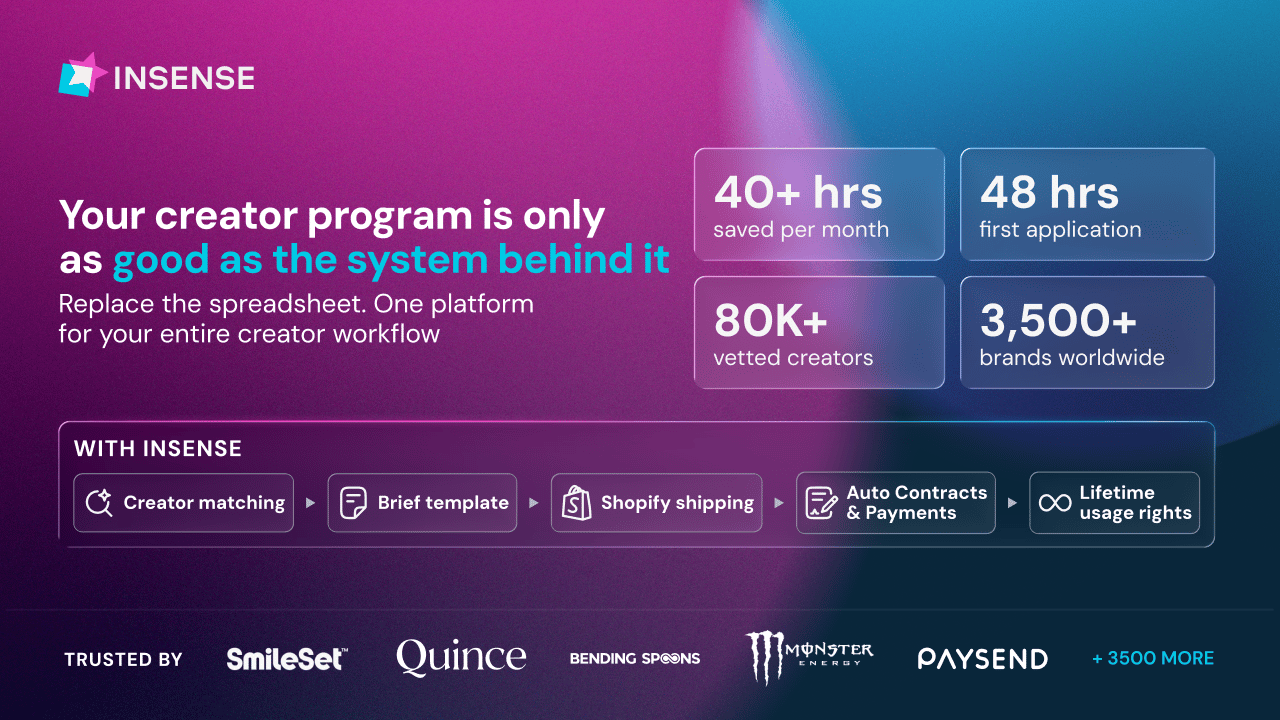
One place to receive creator matches from 80,000+ vetted profiles, run briefs, ship product, automate contracts and payments, and own full lifetime content rights. The results speak for themselves:
Nurture Life cut turnaround time from 2 months to 2 weeks using just one marketer and Insense
Solawave received 180+ ad-ready assets in a single month by simply shipping products
Matys Health achieved 12× reach through Spark Ads on TikTok
Over 3,500+ brands, like Quince, Monster Energy, and Paysend, get first applications in 48 hours and save 40+ hours a month. That's what fixing the workflow looks like.
🚀Quick Hits
🤖 Meta is developing AI agents that can complete tasks on users’ behalf across its apps, including shopping, content management, messaging actions, and automated social media activities with minimal input.
💼 LinkedIn launches an Ad Agency Certification program that verifies expertise in LinkedIn Ads through training, best practices, and performance standards, giving certified agencies official badges and platform recognition.
🎬 Meta adds new analytics tools to Edits, including engagement comparisons, follower insights, peak activity tracking, caption controls, and updated visual editing effects for video creators.
🔎 Microsoft says AI-generated answers require a smarter search index focused on factual accuracy, source attribution, freshness, and conflict detection, rather than only ranking pages by traditional relevance signals.
💪Tweet Of The Day
Advertise with Us
70% of email clicks are bots but not with The Playbook. Reach real human buyers with verified clicks and only pay for actual engagement.
You’ve got the plan—now it’s time to execute. Thanks for being part of The Playbook squad! Let us know if this was helpful so we can keep the play strong with all the right ploys.