- The Playbook
- Posts
- Traffic volume means nothing
Traffic volume means nothing
😮 Pipeline metrics tell you where in the funnel your money is actually disappearing, and more!

Welcome to The Playbook—your backstage pass to marketing mastery. We don’t just share tips; we hand you strategies to dominate the field. Get ready and make bold moves in the ever-evolving marketing game. 🎯
😮Traffic volume means nothing
Lead volume is the metric that keeps agency relationships alive and businesses underfunded. The pipeline metrics that actually tell you what's working sit one layer deeper, and almost no one tracks them back to the campaign level.
Track Lead-to-Opportunity Rate by Campaign, Not Just Total: If 100 leads produce 5 opportunities, the aggregate hides more than it reveals. Campaign A produces 40 leads at 20% opportunity rate. Campaign B produces 60 leads at 2%. Total looks fine.
Reality: Campaign B is burning budget on leads that die at first contact. Segmenting by campaign, ad group, and keyword is the only way to find where quality actually lives.
Connect Google Ads to your CRM via UTM parameters at the campaign and ad group level. Without this, you're flying blind on which campaigns produce pipeline.
Pull a monthly report: leads by campaign vs. opportunities created. Sort by opportunity rate descending. Top campaigns get budget. Bottom ones get paused.
Set a minimum opportunity rate threshold, typically 10-15% for B2B. Anything below it is a targeting or messaging failure, not a volume problem.
When Opportunity Rate Drops, Look at the Offer First: A low lead-to-opportunity rate is almost always diagnosed as a targeting problem. It's usually an offer problem. If the ad promises something your sales team can't deliver, the lead shows up with mismatched expectations and disqualifies itself. If sales keeps saying "these leads aren't ready," the ad is the first place to investigate.
Run a monthly debrief with sales: what are leads expecting? Compare that to what the ads promise. The gap is the offer misalignment.
Test a specific offer against a generic one. Specific offers attract leads who already understand the value exchange.
If using lead forms inside Google, simpler forms produce lower intent signals. Add friction deliberately for higher-value products.
Opportunity-to-Customer Rate Is Not an Ads Problem, But It Is Your Problem: When opportunities don't close, the instinct is to blame the leads. The actual culprit is almost always the sales process, pricing structure, or a product-market fit gap. Google Ads can get the right person into the room. It cannot close the deal.
Map your pipeline stages and tag where deals stall most often. If 80% of opportunities die at proposal, that's a pricing or sales process issue, not an ad issue.
Share pipeline stage data with whoever manages your Google Ads. Context about where deals die changes how campaigns are briefed and optimized.
If the opportunity-to-customer rate is below 20%, fix the sales motion before increasing ad spend. More volume in a broken funnel accelerates the problem.
Pipeline metrics tell you where your money is actually disappearing. Without them, you're optimizing the top of a funnel you've never mapped.
Partnership with PrettyDamnQuick
Your Checkout Has Issues. It Just Won't Tell You.
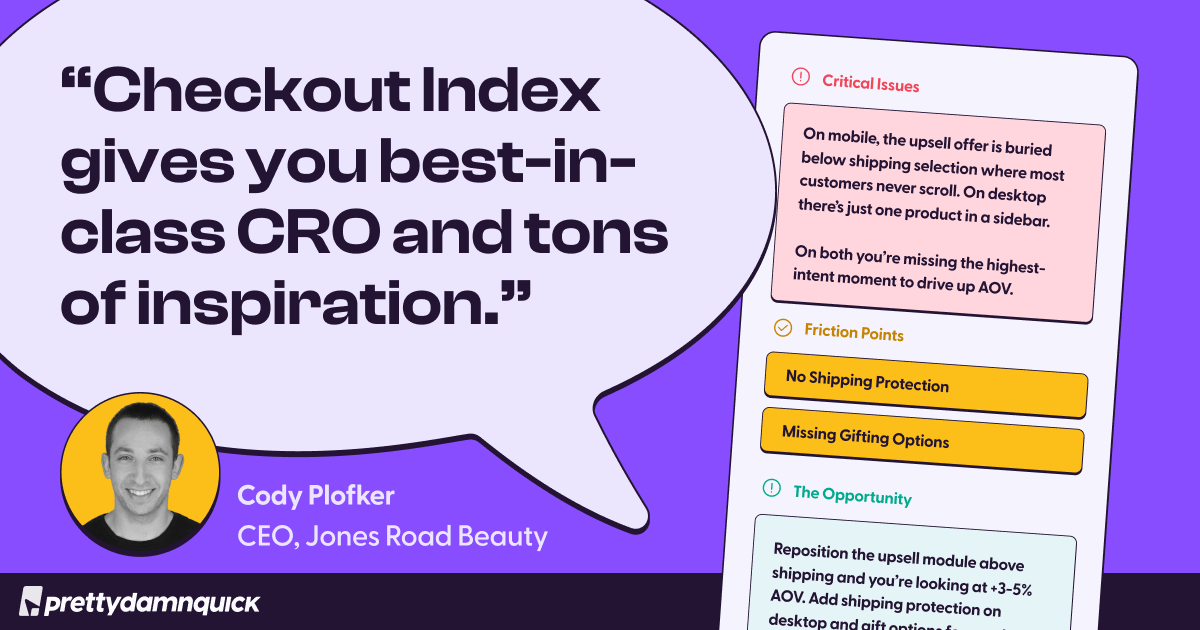
Most checkout tools tell you your CVR. Checkout Index tells you why it's leaking and exactly where to fix it.
Jones Road Beauty ran their checkout through Checkout Index, expecting nothing. They found one critical issue and two friction points they'd completely missed, including upsells buried so deep in the flow that customers couldn't act on them.
Checkout Index projected a 3-5% AOV lift from one placement change.
That's the thing about checkout. The leaks are quiet. Shipping options that overlap so customers won't upgrade. Upsells invisible on mobile. Progress bars are showing the wrong threshold. None of it trips an alarm. All of it costs you.
Checkout Index benchmarks your store against millions of orders across 500+ brands.
Enter your URL, and in 60 seconds, you get a personalized score and projected revenue impact.
No install. No demo call. Just a URL.
🚀Quick Hits
🎵 YouTube is testing AI tools to generate royalty-free music for replacing copyrighted audio and introducing context-based bulk comment moderation to help creators manage replies more efficiently.
🎬 Instagram is testing a “Swap” feature that lets users replace text on others’ Reels, enabling quick edits to existing content while allowing creators to opt out of having their videos modified.
🔍 Google expands Preferred Sources globally, allowing users to select favored publishers across all languages, making it a broader SEO signal that influences visibility in Top Stories and Discover without overriding relevance.
📊 Microsoft Ads adds conversion and spend data to Performance Max placement reports, allowing advertisers to see which publisher URLs drive results and make more informed optimization and exclusion decisions.
💪Tweet Of The Day
Advertise with Us
70% of email clicks are bots but not with The Playbook. Reach real human buyers with verified clicks and only pay for actual engagement.
You’ve got the plan—now it’s time to execute. Thanks for being part of The Playbook squad! Let us know if this was helpful so we can keep the play strong with all the right ploys.